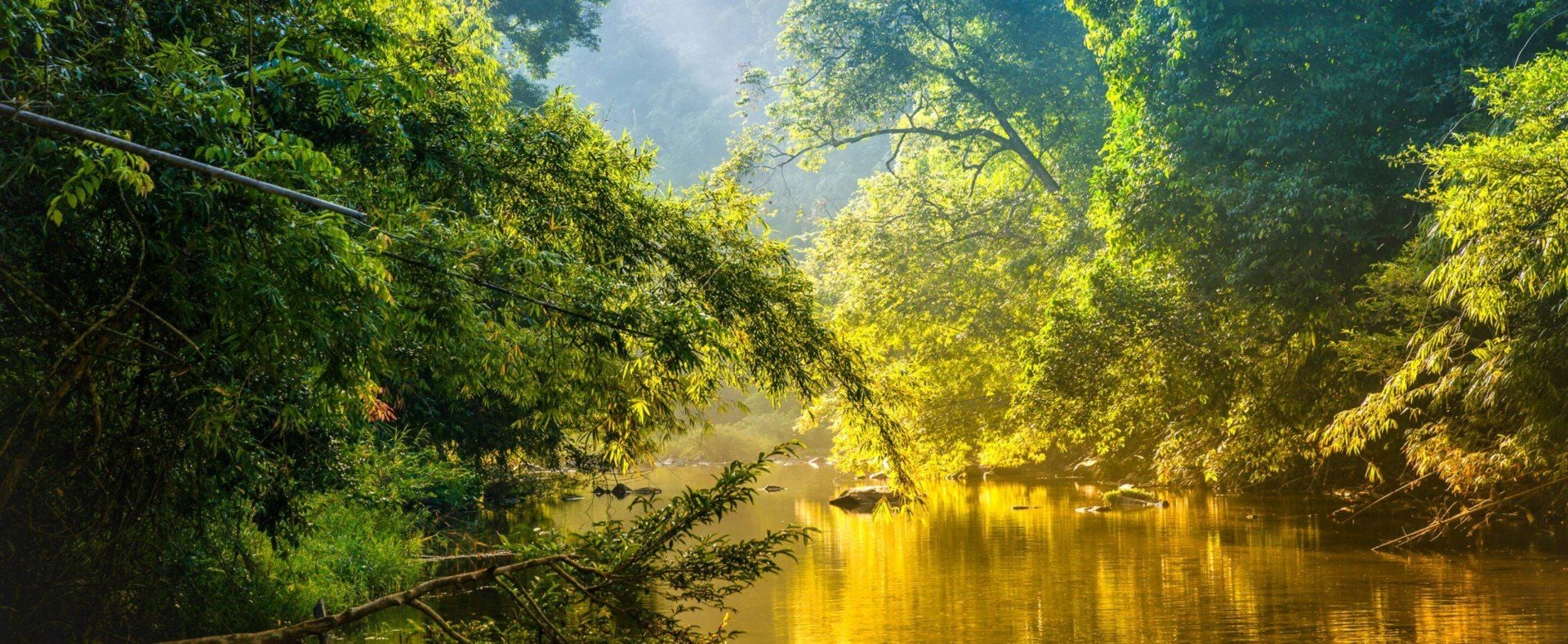
Quick answer: The Amazon is a year-round destination, and the best time depends on how you want to experience it. The low-water season (roughly June to November) is drier, with exposed forest trails, river beaches, concentrated wildlife, and fewer mosquitoes — the sweet spot for most travelers. The high-water season (December to May) floods the forest, letting boats and canoes glide deep among the treetops on an Amazon river cruise. Browse our Amazon tours to match a trip to the season.
Is it a good time to visit right now? Yes — the Amazon has no summer or winter. It stays hot and humid all year, with daytime highs around 86–91°F / 30–33°C in Manaus, Iquitos, and Puerto Maldonado and mild, sticky nights. What changes through the year is the river level, not the temperature. And while it rains year-round, the showers are usually short — an hour or two — rather than all-day downpours.
Because the temperature barely moves, the calendar that matters in the Amazon is the rise and fall of the river. Here is what to expect month by month:
| Month | River Level | Rainfall | Best For |
|---|---|---|---|
| January | High, rising | Wet | Canoeing the flooded forest, birdlife, cruises |
| February | High | Wettest | Deep canoe access, swimming in blackwater creeks |
| March | High (peak) | Wet | Highest water — cruises reach deepest |
| April | High | Wet, easing | Flooded-forest canoeing; very lush |
| May | High, starting to fall | Drying | Good all-round; transition month |
| June | Falling | Drier | ★ Trails open, wildlife concentrating |
| July | Low | Drier | ★ Hiking, piranha fishing, fewer mosquitoes |
| August | Low | Dry | ★ River beaches, wildlife, canopy walks |
| September | Lowest | Driest | ★ Prime wildlife & trails, fewest bugs |
| October | Low | Warm, dry | ★ Wildlife, beaches, clear trails |
| November | Low, rising late | Rain returning | ★ Good shoulder; wildlife |
| December | Rising | Wet | Canoe & cruise season begins |
★ = low-water season, the prime window for wildlife spotting and jungle hikes. See our full Amazon weather guide for more detail.
The Amazon spans several countries, and the ideal base shifts a little with the season:
Not sure which base suits you? Our things to do in the Amazon guide and trip planners can build a route around the season you are travelling.
“The Amazon is my happy place - for me, any time of the year is a great time to visit. However, if I had to choose, I would say the best time to go to the Amazon is from September to November. There is less rain which makes it ideal for visiting a lodge. Also the water levels are lower so you can do more land-based activities such as trekking, bird spotting, and there will be less mosquitos! You’ll also enjoy fewer crowds in the other destinations you’ll visit during this time as it is the shoulder season.”
Rebecca Deering
Amazon Travel Expert
The high water season occurs from December to May. During these months, the Amazon river is at its highest. As the rain comes down, the Amazon basin starts to flood, and boat excursions become a much deeper adventure. With the extra water in the river, travelers are able to see some of the wildlife that may have hidden from the main course of the river. Also, guests are able to swim in the beautiful blackwater creeks!
Note: During the high water season, rivers rise high in the Amazon Basin. In general, all rivers are accessible and allows travelers to explore the rainforest easily by canoe, boat, and/or cruise. In contrast, some of the trails may be flooded due to the rain, and not accessible.
Amazon’s weather in the high water season is considered the colder and wet season. Though, keep in mind that it is warm in the Amazon any time of the year. Temperatures won’t drastically fall. In December, Manaus cools down to 88F / 31C and by May, the temperature can get as low as 75F / 23C, which is relatively low for the Amazon.
When the water levels are high in the Amazon, the best thing to do is indulge in water-based activities. We recommend taking an Amazon cruise, canoeing, kayaking, or spotting marine life. During the high water season, choose a cruise from places like Iquitos Peru, Coca Ecuador, and Manaus Brazil. These are all great places to begin an Amazon cruise adventure.
The low water season lasts from June to November. As the water starts to recede, forest animals, fish, and pink dolphins that have spread out in the flooded rivers become more concentrated. And as the extra water begins to drain from the wetlands, forest walks become popular, as the trails are clear and lead guests deeper into the rainforest. During this time, guests enjoy fishing for piranha alongside a local guide.
The low water season is the “warmer” season in the Amazon, and despite its name, this time of year receives some short, but heavy rainfall. In June, the average temperature of Manaus is around highs of 87F / 30C. By November, Manaus can reach as high as 90F / 32C.
During the low water season, guests can enjoy land-based excursions such as hiking, trekking, canopy climbing, ziplining, and wildlife spotting. All lodges offer guided hikes and access to surrounding trails. Whether you embark on an educational hike and learn about the ecosystem that surrounds you, or you hike to a tall canopy bridge where you can overlook the rainforest, hiking and trail walking is the best during the dry, low water season.
Note: Some of the rivers aren’t navigable during the “low water” season. Instead, hiking trails are more accessible during this time and allow explorers to venture deeper into the lush jungle.
The Amazon is rewarding year-round. The low-water season (June–November) is drier, with open forest trails, river beaches, concentrated wildlife, and fewer mosquitoes — the best all-round window. The high-water season (December–May) floods the forest, ideal for canoeing and cruising deep among the trees. Many of our specialists rate September to November as the single sweet spot.
During high water (Dec–May) the river rises many metres and floods the forest, so you explore by boat and canoe and can glide right in among the canopy. During low water (Jun–Nov) the river retreats to expose trails and sandy beaches, wildlife gathers around the shrinking channels, and jungle hiking comes into its own. Neither is "better" — they are simply two different Amazons.
The drier, low-water season runs roughly June to November, with September and October the driest. It never stops raining entirely — the Amazon is a rainforest — but showers in these months are shorter and less frequent, and the lower water opens up hiking trails and river beaches.
Amazon river cruises operate year-round. At high water (December–May) boats float deepest into the flooded forest, bringing you eye-level with canopy wildlife; at low water (June–November) you see more river beaches, exposed banks, and animals gathered along the shore. Both make superb cruising.
The drier low-water months — roughly June to October, and especially September — bring the fewest mosquitoes, since there is less standing water for them to breed in. Blackwater areas (like parts of the Peruvian and Brazilian Amazon) also have naturally fewer mosquitoes than whitewater rivers year-round.
Yes. In the low-water season animals concentrate around the shrinking channels and beaches, making them easier to spot on foot and from small boats. In the high-water season you drift by canoe among the treetops, closer to monkeys, sloths, and birds in the canopy. Pink river dolphins, caimans, and macaws are around all year.
Both are excellent and follow a similar water calendar. The Peruvian Amazon (Iquitos, Puerto Maldonado, Manu) is famed for luxury cruises — best at high water — and wildlife-rich lodges best in the dry season. The Brazilian Amazon around Manaus shines at low water, when river beaches and trails emerge. Your choice usually comes down to which itinerary and lodges you prefer rather than the country.
It can, but rarely for long. Even in the wet season the rain usually falls in short, heavy bursts of an hour or two, often clearing to sunshine — prolonged all-day rain is uncommon. Temperatures stay warm and humid throughout, so a passing shower is rarely a reason to change your plans.
