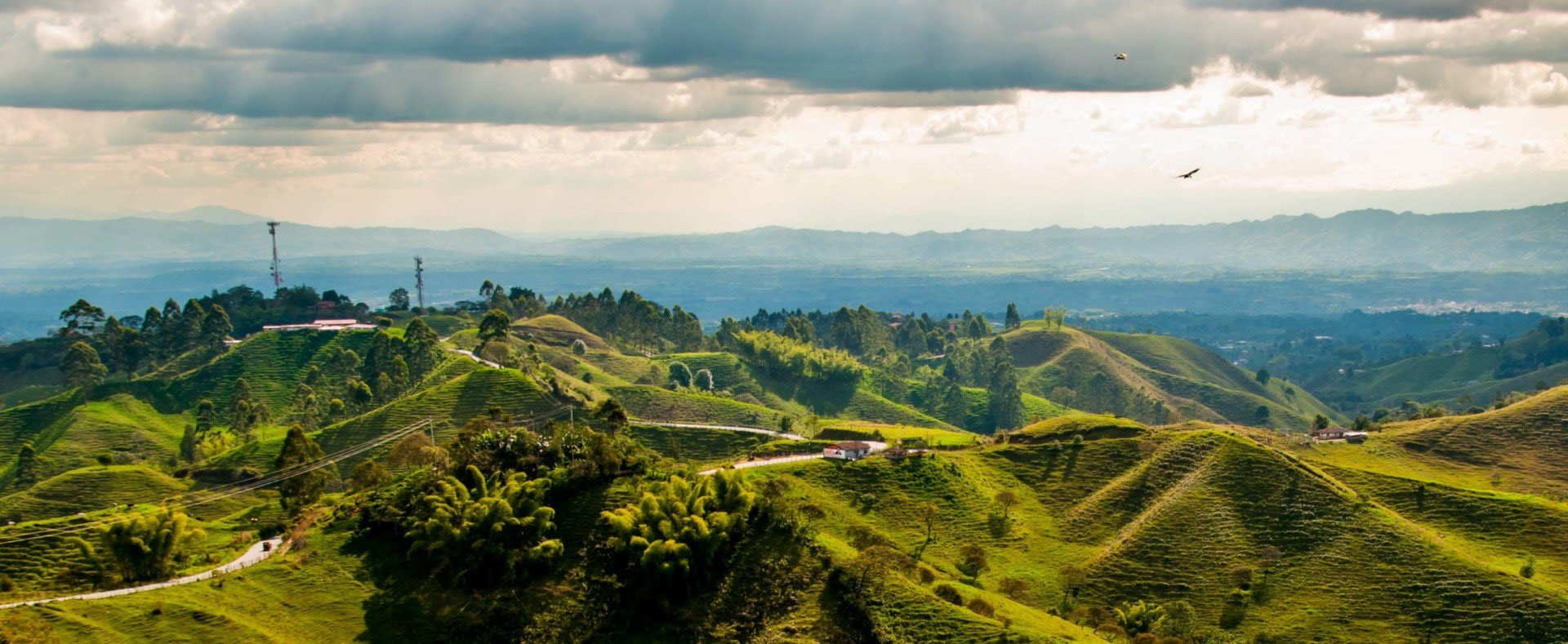
Rolling green hills stretch into the distance under a partly cloudy sky, with scattered houses, winding roads, and trees—an inviting scene for Colombia travel. Birds soar overhead as mountains rise above a hazy horizon in the background.
Colombia Tours

Languages of Colombia

Icon
Colombia Overview
Best Time to Visit Colombia
Icon
Colombia Articles
Icon
Colombia Recommended Hotels
Icon
Staying Healthy in Colombia
Icon
Colombia Travel Insurance
Icon
Internet & Calling in Colombia
Icon
Colombia Packing List
Icon
Colombia Flights
Icon
Weather in Colombia
Icon
Money in Colombia
Icon
Languages of Colombia
Icon
Colombia Food & Drink
Icon
Safety in Colombia
Icon
Colombia Visa Requirements
Icon
Things to do in Colombia

Language Information

When traveling to a foreign country, it’s always a good idea to have a few basic phrases of the official language handy. Even if you completely mispronounce a word or a phrase, the locals will appreciate you attempting to speak their language. In Colombia the official language is Spanish. The accent varies depending on the region you visit. Many claim that Colombian Spanish is the “purest,” and most clearly spoken in all of Latin America. So if you have any background of Spanish, you will most likely be able to understand Colombians just fine. It’s in Argentina, where you may have the most trouble understanding the dialect. With that being said still, different regions of Colombia have different accents and ways of pronunciation. Once you get used to clear and neutral accent of the capital of Bogota it will be quite challenging to understand the same language on the streets of Cartagena or Medellin. Every region has its peculiar accent, on the Caribbean coast locals tend to speak very fast and loud whereas in the south of the country they speak softly almost whispering. Each region and department has its own dialects and slang. Studies show there are 11 main dialects in Colombia, the one used in Bogota is called Rolo. Here are some common Colombian words that are not common in other Spanish speaking countries:
  • Sumerce – very old word used more in the XVI-XVII century, a way to say “you” in a very respectful way. Nowadays still used in some areas of Colombia to show respect, e.g a child can say to a parent: gracias, Sumerce.
Colombians have also an interesting way of saying hello. When friends meet they usually say: “Que mas?” which one could translate into “what’s new?” “what’s up?”. Among friends Colombians name women “vieja” (literal meaning – old) and men “man” or “parcero”. When something is great they will say: “que chevere” or “que bacano”, “que chimba” (this one can be used also in a negative way). And if they are really enthusiastic about something they will say “de una!” which could translate into “Let’s do it!”. Some particularly Colombian phrases and slang used in everyday language include:
  • “mamar gallo” – joking around
  • “tener guayabo” – to have hangover
  • “bien o no? – how are you?
  • “que mas pelado” – what’s up man?
  • “que pena” – I’m sorry
  • “echar los perros” –to flirt with someone
  • “rumbear” – partying
  • “esta muy chimba” – it’s really cool
  • “por si las moscas” – just in case
  • “camello tan verraco”- such a hard work
  • “tomar polas” – have beer
  • “fresco, todo bien” – it’s cool, all fine
Most Colombians learn English in school, and enjoy watching Hollywood films, giving them a basic understanding of English. It’s common for teenagers and children to try and practice their English with foreigners. So if you have a basic understanding of Spanish, you can help them as they help you! You don’t need to worry about language barriers at hotels, restaurants, and major tourist locations. The staff at those locations will speak English well. Church rises above rooftops of valley city
