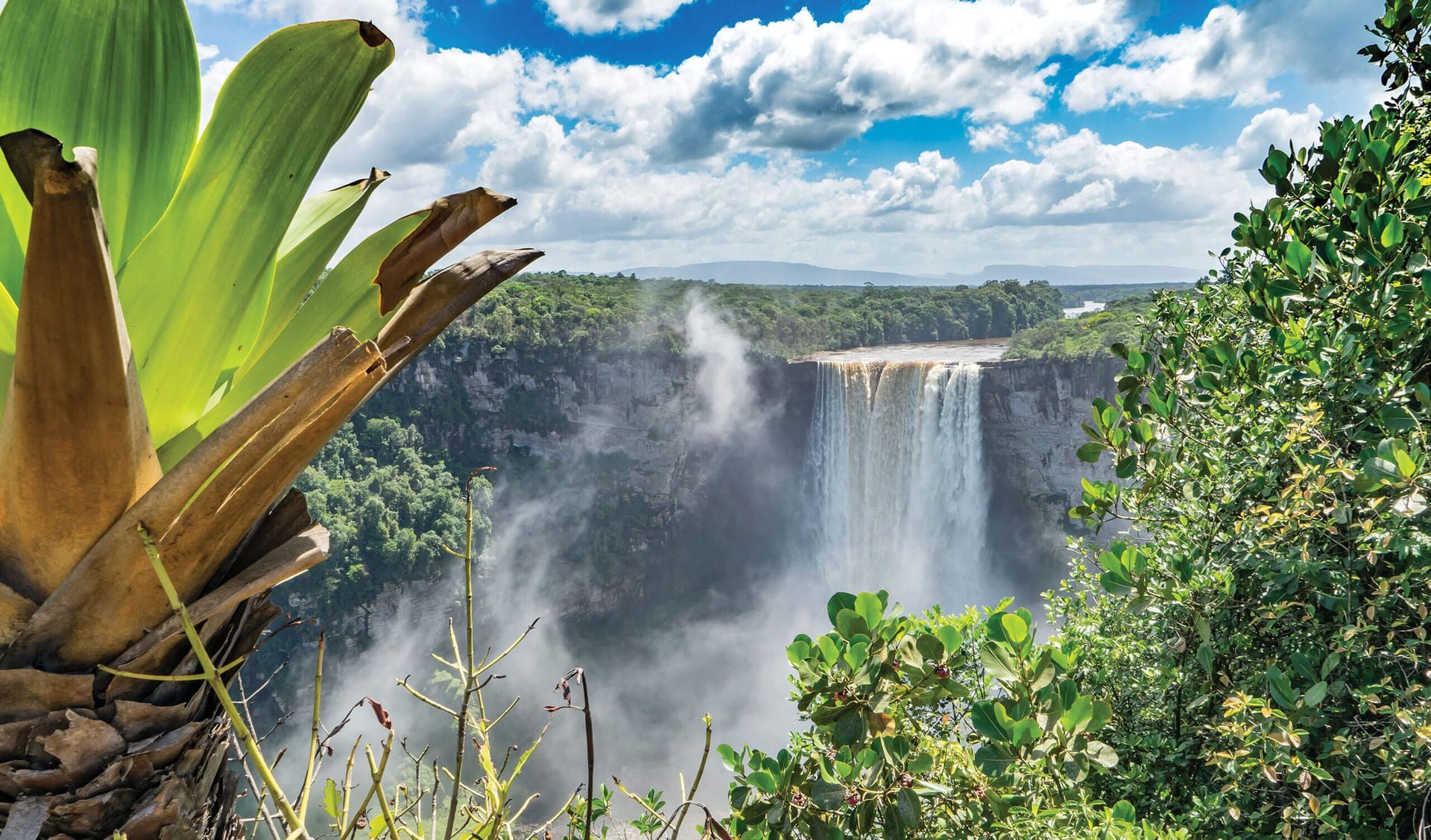
A wide waterfall cascades over a forested cliff under a bright blue sky in Guyana, surrounded by lush green foliage and large tropical plants. Discover the breathtaking scenery and learn the best time to visit this natural wonder.
For an incredible experience and memories that last...

Best Time to Visit Guyana, French Guiana, & Suriname

When Is the Best Time to Visit the Guianas?

Quick answer: The best time to visit the Guianas — Guyana, Suriname, and French Guiana — is during their two dry seasons: the long dry from mid-August to November and the short dry from February to April. These windows, just after the rains, are when the rainforest is green and lush, Kaieteur Falls is thundering, wildlife is active, and unpaved roads and trails are at their most passable. Browse our Guianas tours for ideas.

Is it a good time to visit right now? The Guianas sit just north of the Equator, so it is hot and humid all year (daytime highs around 86–88°F / 30–31°C) with no summer or winter. The calendar that matters is rainfall: two wetter spells (a long one May to mid-August, a short one in December–January) alternate with the two drier, easier travel seasons.

Guianas Weather & Rainfall Month by Month

Temperatures barely move through the year, so the table below focuses on rainfall — the thing that actually shapes when to go. It applies broadly to all three countries (Georgetown, Paramaribo, and Cayenne share a similar pattern):

Month Rainfall Kaieteur Falls & Wildlife Verdict
JanuaryShort wetFalls full◐ Green, some rain
FebruaryShort dryDrier, accessible★ Good — short dry
MarchShort dryGreen & drier★ Good
AprilDry endingTurtle nesting begins◐ Shoulder
MayLong wet beginsFalls thunderous; turtles● Wet
JuneLong wetFalls at their fullest; turtles● Wettest
JulyLong wetWet; turtle hatchlings● Wet
AugustDrying mid-monthFalls full, forest lush◐ Improving late
SeptemberLong dryFalls full, lush, active wildlife★ Best — green & dry
OctoberLong dryExcellent conditions★ Best
NovemberLong dryGood; wildlife active★ Best
DecemberShort wetFalls full◐ Festive, some rain

★ = dry seasons, the best time to travel · ◐ = shoulder · ● = wettest (Kaieteur at its most powerful; sea-turtle nesting). See our full Guianas weather guide for detail.

The Best Time to Visit Each of the Guianas

  • Guyana — English-speaking, with Kaieteur Falls, the Rupununi savannah (giant anteaters, giant river otters, and jaguars), and Iwokrama rainforest. Best in the dry seasons, September–November and February–April, when trails and river travel are easiest.
  • Suriname — Dutch-speaking, with the UNESCO-listed capital Paramaribo and the vast Central Suriname Nature Reserve. Same dry windows are ideal; the wetter months are prime for sea-turtle nesting at Galibi.
  • French Guiana — an overseas region of France, home to Cayenne, the former penal colony of the Îles du Salut (Devil’s Island), and the Guiana Space Centre at Kourou. Driest and easiest to explore from August to November.

Planning a trip? Our things to do in the Guianas guide can help you time the falls, the rainforest, and the coast.

My Recommendation

"Just after one of Guyana's two rainy seasons have ended, there will be lots of water flowing over the Kaieteur Falls and the country will be even more green and lush than during the rest of the year! This means the end of August to early September and the start of February are good times to visit."

Sales Director, Rebecca Deering

South America Travel Expert

Visiting Guyana in the Dry Seasons

Beautiful shot over the top of Kaieteur Falls in Guyana during Dry Season

The Dry Seasons in Guyana (September - November & February - April)

Guyana has two dry seasons, one beginning in September and the other in February. During these times, in the country’s interior, roads are more accessible, making for easier travel around the forested regions and wild savannahs of Guyana. Additionally, mosquitoes and other biting insects will be less common than in the rainy season. When flying to Kaieteur Falls, there are good chances of spectacular views from the plane.

Guyana Weather in the Dry Seasons

Guyana is a tropical country and the climate is similar to that of the Amazon Rainforest. In the dry seasons, you can expect average high temperatures of about 31°C / 88°F. By night, temperatures remain high at around 24°C / 75°F. Even though these are the driest times of the year, you should still be prepared for some rainfall. Cool, quick-drying clothing with long sleeves is ideal for travel in Guyana.


Georgetown

Guyana Weather in the Dry Seasons

20ᵒ C / 81ᵒ F

Lethem

Guyana Weather in the Dry Seasons

20ᵒ C / 68ᵒ F

Paramaribo

Guyana Weather in the Dry Seasons

32ᵒ C / 90ᵒ F

Things to Do in Guyana During the Dry Seasons

The dry seasons are fantastic times for hiking and exploring the rainforests and savannahs of Guyana. Famed for its natural and isolated beauty, a visit to Guyana is centered around ecotourism. Opt for a hike in the renowned Kaieteur National Park, or horse-ride and search for giant anteaters in the savannah. At the start of the dry seasons, the interior of Guyana will be lush and Kaieteur Falls is swollen from recent rainfall. For a real adventure, stay overnight at the simple Kaieteur Falls guest house allowing you to watch swifts roost behind the falls in the evening and see the falls at sunrise the next day before anyone else arrives.

For a break from the heat, journey around Guyana’s beautiful coastline. Along the coast and a little way up the Essequibo River is Baganara Island Resort - an ideal place for relaxation as well as activities such as kayaking, paddle boarding, and swimming.

In Georgetown, visitors can go sightseeing and visit the botanical gardens where giant water lilies can be seen. Be sure to visit popular sites like Stabroek Market and St. George’s Cathedral - the world’s largest wooden cathedral. A culinary tour is also a great way to explore Georgetown.

Birdwatching during Guyana’s dry season is a must. Look out for favorites like the Guianan Cock-of-the-Rock and the rare Harpy Eagle. In the Rupununi Savannah, over 250 species of bird can be spotted, with 18 unique to the region alone.

Visit Guyana’s Amerindian communities and stay in a locally run eco-lodge in the jungle. Expert guides will show you the secrets of the rainforest and can even take you fishing for giant arapaima.

Visiting Guyana in the Rainy Seasons

Wide horizon shot over a Guyana Savannah during Rainy Season

Rainy Seasons in Guyana (December - January & May - August)

Guyana has two wet seasons, one from December to January along the coast and a longer one from May to August throughout the country including the coast. What this means for travelers is that while December to January is not great weather in the capital, once you’re further inland this is a perfectly reasonable time of year to travel. As a general rule, May to early August are not good months to travel to the interior of Guyana as it can be difficult to get around especially as many roads are unpaved.

Guyana Weather in the Rainy Season

During Guyana’s rainy seasons, you can expect heavy downpours on most days. The rainfall can provide a welcome break from the humidity. Temperatures are similar to during the dry seasons at about 31°C / 88°F by day. Insects can be more problematic during the rainy seasons. Rainfall doesn’t usually last the whole day, often just a couple of hours, clearing to sunny weather.


Georgetown

Guyana Weather in the Rainy Season

20ᵒ C / 81ᵒ F

Lethem

Guyana Weather in the Rainy Season

20ᵒ C / 68ᵒ F

Paramaribo

Guyana Weather in the Rainy Season

32ᵒ C / 90ᵒ F

Things to Do in Guyana during the Rainy Seasons

If traveling from December to January, head away from the coast to the savannahs as the weather is still good there at this time. In the savannahs, the top things to do are look for anteaters and horseback around the exotic terrain.

In May, Georgetown holds its annual carnival so despite the rain this is an interesting time to visit. The weather won’t prevent tours in the city and along the coast, so these are the best options in these months. Guyana’s food tastes good all year round, so try a culinary tour!

When to Visit the Guianas: Common Questions

The best time to visit Guyana, Suriname, and French Guiana is during the two dry seasons — the long dry from mid-August to November and the short dry from February to April. Just after the rains, the rainforest is lush, Kaieteur Falls is full, wildlife is active, and roads and trails are most passable.

There are two wet seasons: a long rainy season from May to mid-August and a shorter one in December–January. The rains bring dramatic waterfalls and turtle nesting, but heavier downpours can make some inland roads and trails difficult, so many travelers prefer the drier months.

The main dry season runs from mid-August to November, with a second, shorter dry spell from February to April. These are the easiest times for rainforest lodges, river trips, and wildlife-watching, and the forest stays green from the rains that came just before.

Kaieteur Falls in Guyana is spectacular year-round. It carries the most water during and just after the long rainy season (roughly May to August), when it thunders at its most powerful. For the best balance of a full waterfall with easier travel and clear skies, the early dry season around September is ideal.

Yes — lying just north of the Equator, the Guianas are hot and humid all year, with daytime highs around 86–88°F / 30–31°C and warm nights. There is no cool season; what changes is the rainfall. Lightweight clothing, rain protection, and insect repellent are essential whenever you go.

Guyana's Rupununi savannah and Iwokrama rainforest are best in the dry season (September–November and February–April), when animals gather around shrinking water sources and tracks are passable. This is prime time to look for giant river otters, giant anteaters, black caimans, and — with luck — jaguars.

Giant leatherback and green turtles nest on the beaches of Suriname (Galibi) and French Guiana roughly from April to July, with hatchlings emerging into about September. This falls during the wetter season, so it is the one great reason to visit in the rains — an unforgettable wildlife spectacle.

Both share the region's climate, so the dry seasons — the long dry August–November and the short dry February–April — are the most comfortable for exploring Paramaribo, the rainforest reserves, and French Guiana's coast and Space Centre. Time it with the wetter months only if sea-turtle nesting is your goal.

South America Travel Guide PDF Cover Page.
Download your free

South America Travel Guide

Download our FREE South America Travel Guide and get inspired to explore to South America. Browse through 26 pages of travel planning tips and ideas – a great resource for planning your dream vacation.
  • Colorful maps and images
  • Unique hotels within South America
  • Inspiration for cruises, remote lodges and trains
  • Wine, golf and adventure ideas
  • 24 top tours of South America
