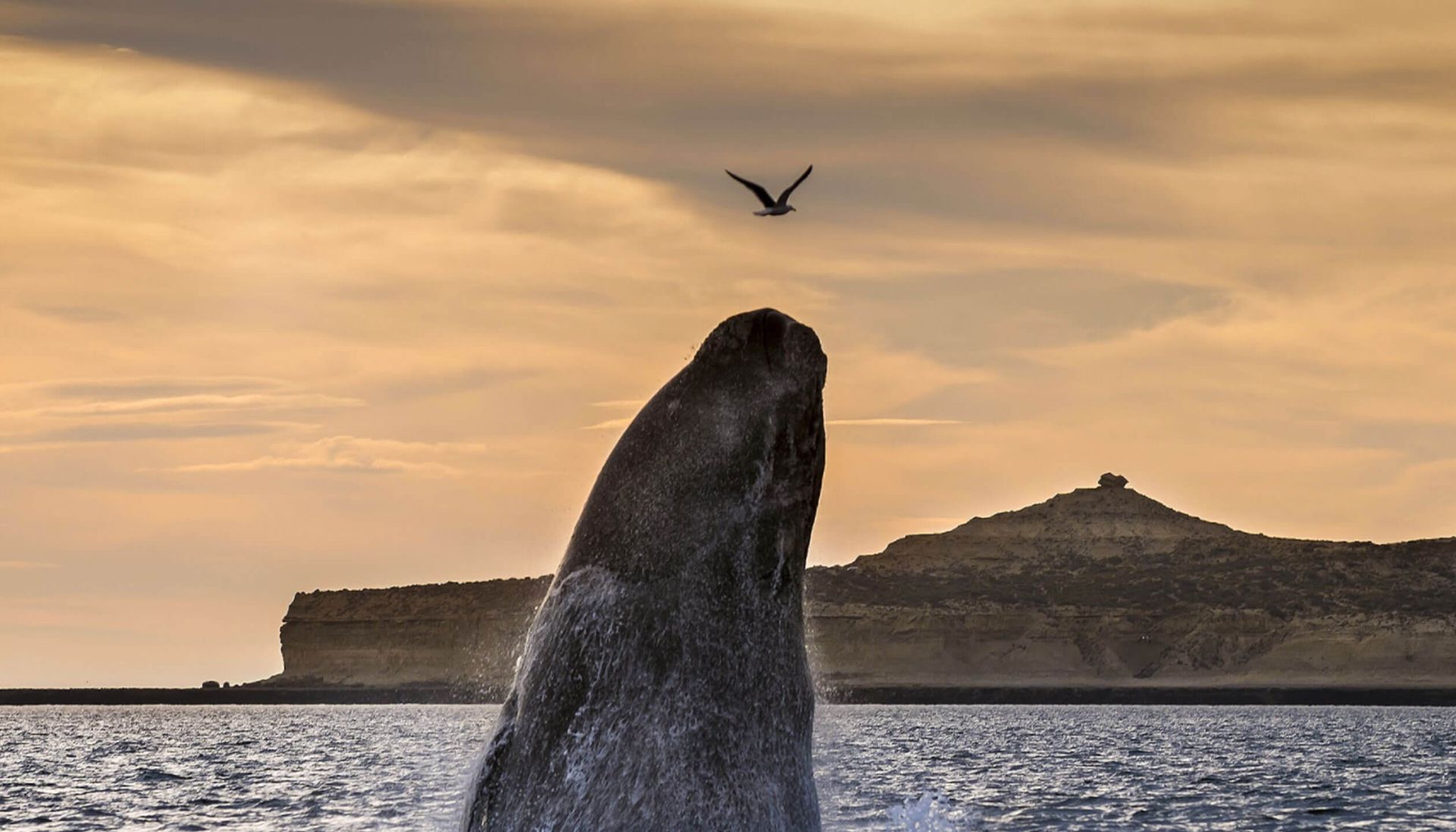
Península Valdés is a blunt hook of land on the Atlantic coast of Argentina, joined to the mainland by one narrow isthmus and holding a sheltered gulf on either side. It has been a UNESCO World Heritage site since 1999, listed for its marine mammals rather than its scenery. Southern right whales calve in the gulfs. Sea lions and elephant seals hold the beaches. Orcas work the tide at Punta Norte. Magellanic penguins nest in huge numbers at Punta Tombo, which is south of the peninsula and a separate trip.
Here is the part most pages leave out. What you see depends almost entirely on the month you arrive. The whales belong to winter and spring, the orcas to late summer, the penguins to the warm half of the year, and no single week hands you all three. So read the calendar below before you fix your dates, then build the trip around the animal you came for. The rest of the country runs on its own schedule, which is what best time to visit Argentina is for.
The only trip of ours built around this wildlife rather than passing it: the Punta Tombo rookery and a Valdés excursion in the first half, then Los Alerces National Park, a Patagonian estancia and Bariloche in the second. It does not include El Calafate or Ushuaia.
Puerto Madryn and the peninsula first, then El Calafate for the glaciers and Ushuaia at the end, which is the standard Patagonia shape with Valdés attached to the front. Punta Tombo is not included, and departures run October to mid-April, so the opening months of whale season fall outside them.
Seventeen days with the railways doing the work: the Tren de la Costa out of Buenos Aires, south along the Atlantic coast to Valdés, then west to the Chilean lakes and the La Trochita steam line before Santiago. Valdés is one stop among many here, Punta Tombo is not on it, and train schedules shift through the year, so the dates get checked before anything is fixed.
Buenos Aires, then Puerto Madryn and the peninsula, then the glaciers at El Calafate, Torres del Paine and an Australis sailing through the Strait of Magellan and the Beagle Channel. Punta Tombo is not on it, and the land days have to fit the cruise departures rather than the whale calendar.
The long version, and the other itinerary that carries both Valdés and Punta Tombo: Santiago and Valparaíso first, then Torres del Paine, an Australis sailing from Punta Arenas to Ushuaia past Cape Horn, and Puerto Madryn with the peninsula near the end. Those sailings run October to March, which covers most of the penguin season and the back half of the whale season.
Three animals, three calendars, and they do not line up.
Southern right whales: June to December, peaking September to November. They calve in the sheltered water of Golfo Nuevo and Golfo San José, and the boats go out from Puerto Pirámides.
Orcas at Punta Norte: mid-February to April, strongest March to mid-April. They ride in on a high tide and deliberately strand themselves on the shingle to take young sea lions. It is the most dramatic thing on this coast and the least reliable, so nobody should be promising it to you.
Magellanic penguins at Punta Tombo: September to April, best November to February when the chicks are out.
Now the overlaps. September to December puts whales and penguins on the coast at the same time, and October and November fall inside the whale peak with the birds already ashore, which is why the wildlife itinerary sits there. Late February to April gives you orcas and penguins and no whales. June to August is whales only, January to mid-February is penguins only, and the weather can still take a day off you in any of them.
Guidebooks blur this, and it costs people days.
Puerto Madryn is a mainland town on the shore of Golfo Nuevo. It is not on the peninsula.
Península Valdés starts past a single narrow isthmus north and east of Puerto Madryn. Inside it are Puerto Pirámides, the only village and the whale harbor, and the lookouts at Punta Norte and Caleta Valdés. The peninsula is about 90 km of pavement from Puerto Madryn to the isthmus and gravel once you are inside it, with 70 km between Puerto Pirámides and Punta Delgada, so the circuit is a full day at gravel speeds.
Punta Tombo is not on the peninsula at all. It lies well to the south, reached by road from Puerto Madryn or Trelew, and it is a full day out and back on its own. Plan it as its own day, never as a stop on a Valdés circuit.
Flights from Buenos Aires land at Trelew or at Puerto Madryn, and either works. Two nights in Puerto Madryn buys you exactly one peninsula day and nothing else. That is the arithmetic behind our usual advice of three.
Patagonia has two halves and they look nothing alike. Valdés is the Atlantic one: low cliffs, scrub, wind, animals. The Andes are the other: glaciers, lakes, peaks. A traveler with one week picks one of them.
With more time there are two sensible pairings. West and north to Bariloche and the Lake District, which is what the wildlife trip does. Or south to El Calafate and Ushuaia, the classic route, which brings in the glaciers and the Beagle Channel. Both legs route through Buenos Aires, because the domestic network radiates from the capital rather than running down the coast.
Juergen Keller, our co-founder, has one rule for Argentina that applies here harder than anywhere: do not travel it as a checklist. A morning boat and an afternoon flight out is a photograph, not a trip. Give this coast three nights and let the wind have one of them. When you go decides the rest.
The only village on the peninsula: one short strip of houses above a shingle beach, and the harbor every whale boat leaves from. Between June and December those boats run out into Golfo Nuevo. Outside the season it is simply a quiet base for the drive to Punta Norte. Sleeping here instead of Puerto Madryn buys you the early light.
The northeastern tip, and the place on the peninsula where orcas hunt on the beach, between mid-February and April. The rest of the year it is a sea lion colony on an exposed shore with a long gravel drive to reach it. The breeding colonies here are a large part of why the peninsula carries its UNESCO listing.
A long gravel spit down the east coast, cut off from the open Atlantic by a shallow channel. You watch from the cliff top rather than the shore: elephant seals hauled out below, sea lions, marine birds working the water. It is the quietest of the three lookouts, and the first one people drop when they try to do the circuit in a morning.
Well south of the peninsula, a very large Magellanic penguin rookery about 185 km from Puerto Madryn, close to three hours each way with the last stretch on gravel. Allow a full day. The colony is empty through the southern winter and fullest in the chick months. If penguins are the whole reason for the trip, a second rookery sits much further south at Cabo Blanco, near Puerto Deseado.
The mainland town on Golfo Nuevo where nearly everyone sleeps, with the hotels, the restaurants and an airport of its own. It is also where the Welsh landed in 1865. Whales come into this gulf as well as the one to the north, so in season they are in the water off the town, not only off the peninsula. Valdés and Punta Tombo both start from here.
The other airport, and the way into the lower Chubut valley, where the Welsh settlers moved inland and left chapels and tea houses still in use. Trelew also has a serious paleontology museum, which is the best thing on this coast to keep for a day the wind takes. Punta Tombo is as easy to reach from here as from Puerto Madryn.
The pages next door carry the rest of the south. Patagonia covers both sides of the border. Bariloche and the Lake District is the Andean half of the wildlife trip. Argentina cruises holds the ships that work this coast and the channels below it. Adventure tours is where the walking and the kayaking live, UNESCO sites lists the peninsula with the country’s others, and Argentina itself takes in everything north of Patagonia.
Because here the calendar is the whole job. The month decides what is in the water, and the wrong fortnight cannot be repaired on arrival. So we start from the animal you came for, work back to the dates, and fit flights and nights around that, not the reverse. We will also tell you where a sighting is luck. October sits inside the whale peak, which is the best the calendar can do for you, and the water still decides. Orcas hunting at Punta Norte are never odds, in any month, and we would rather say so now than have you hear it on the cliff. Twenty-plus years of these trips is mostly knowing which promises not to make.
Planning a trip to South America? Explore essential travel info including via requirements, safety tips, weather, money, and more so you can focus on designing the perfect adventure!
Yes, in the right month. This is a wildlife site before it is a scenic one, and in the wrong weeks it is wind, scrub and an empty gulf. Between June and December the southern right whales are calving in the gulfs, and that alone earns the flight. January and early February are the quietest weeks on the peninsula itself, although the penguins at Punta Tombo are at their best then. Pick the month first.
Not the colony you are thinking of. The Magellanic penguin rookery people travel for is at Punta Tombo, which lies south of the peninsula and is reached by road from Puerto Madryn or Trelew, a full day out and back. The birds are ashore from September to April, with chicks out November to February. The peninsula's own beaches are for whales, sea lions and elephant seals.
On the Atlantic coast of Argentine Patagonia, in Chubut province, roughly halfway down the country. It hangs off the mainland on a narrow isthmus just north and east of Puerto Madryn, with Golfo San José on one side of it and Golfo Nuevo on the other. You reach it by flying from Buenos Aires to Puerto Madryn or Trelew, then driving. It has been a UNESCO World Heritage site since 1999.
October, if you want one answer. Southern right whales are in the gulfs from June to December and the season peaks from September to November, so October sits in the middle of the strongest weeks. The boats leave from Puerto Pirámides. September and November are inside the peak too, so neither is a compromise. June and December are the shoulders of the season.
Sometimes, and only between mid-February and April, with the best chance from March to mid-April. The orcas take young sea lions at high tide, beaching themselves to do it, and it is not a scheduled event. It is not a scheduled event. People sit on that cliff for days and see nothing, and nobody honest will tell you otherwise. Build the trip so the attempt is a bonus, never the point.
You fly to Trelew or to Puerto Madryn, then transfer by road. Most travelers base themselves in Puerto Madryn and drive out to the peninsula for the day. Driving the whole way from Buenos Aires is possible and long, and nobody on a two-week trip should spend it that way. Domestic routes run through the capital, which matters when you stitch this coast to the Andes.
Three in Puerto Madryn is our usual answer and two is the floor. Two nights gives you one day on the peninsula, with no second chance if the wind closes the boats. Three gives you the peninsula, a day for Punta Tombo or the Welsh valley, and a spare. Make it four if orcas are the reason you came, because that one needs patience rather than a forecast.
Thinking of traveling to South America? We take your South American travel dream and make it a reality. Every fully custom South America trip is planned by your own expert personal Travel Consultant.

"*" indicates required fields
Our favorite Argentina tour ideas featuring the best destinations & activities designed to inspire…
Get your FREE Argentina Guide Now!