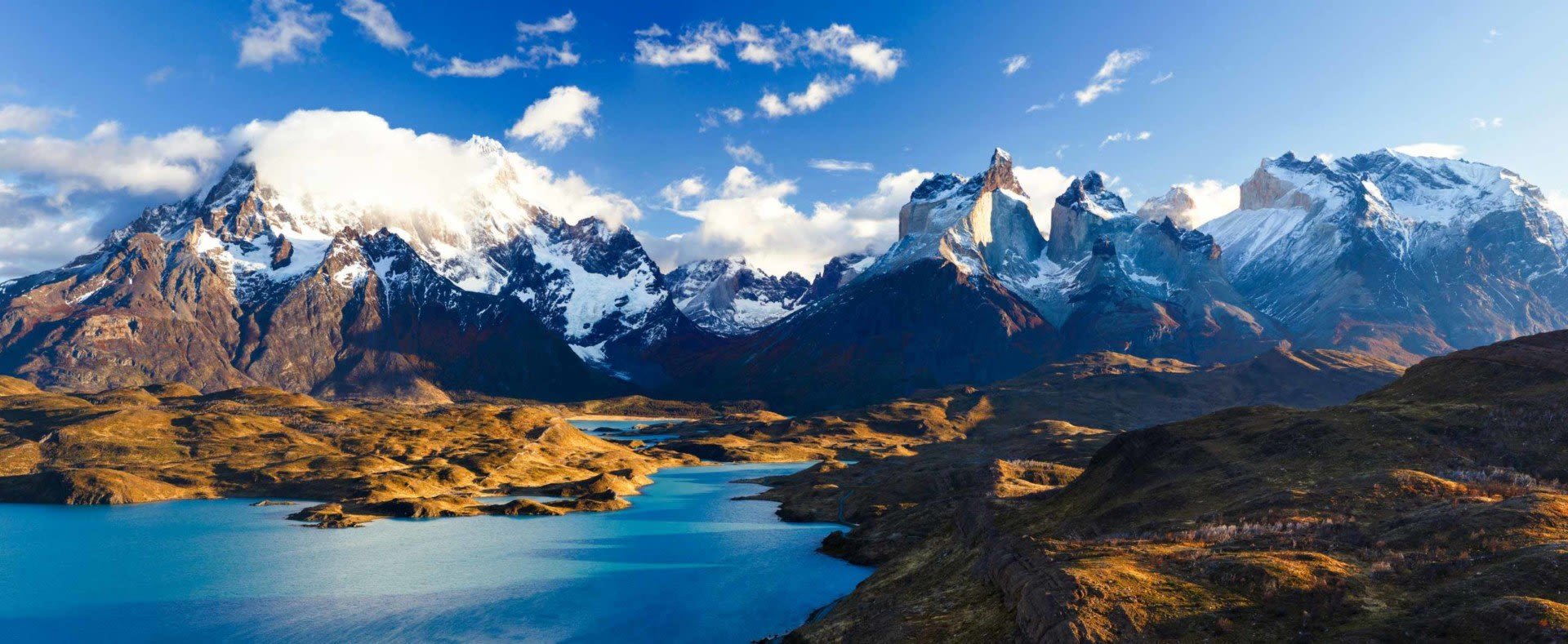
Patagonia is shared by Argentina and Chile, and its rain changes far more from west to east than from month to month. The Andes catch the Pacific rain on the Chilean side and along the border, the Argentine plateau lies in their rain shadow, and the wind blows across both. As for how cold it gets: January afternoons average 56°F (14°C) in Ushuaia and 85°F (29°C) at Trelew on the Atlantic coast, and July nights 24–33°F (−4 to 0°C) at every station below.
Our Argentina weather guide and Chile weather guide cover each country. This page covers the wind, the rain shadow, the long summer days and the weather on the trails.
These are the 1991–2020 climate normals of Argentina’s Servicio Meteorológico Nacional (SMN) and Chile’s Dirección Meteorológica de Chile (DMC), as reported to the World Meteorological Organization, north to south. Strong-wind days have wind above 27 mph (43 km/h), from the SMN’s 2011–2020 records.
| City (station) | Country | January high / low | July high / low | Rain per year | Strong-wind days a year |
|---|---|---|---|---|---|
| Bariloche (airport) | Argentina | 74 / 45°F (23 / 7°C) | 44 / 29°F (7 / −2°C) | 32.0 in (813 mm) | 198 |
| Trelew, near Puerto Madryn (airport) | Argentina | 85 / 57°F (29 / 14°C) | 54 / 33°F (12 / 0°C) | 8.6 in (218 mm) | 103 |
| Coyhaique (Teniente Vidal aerodrome) | Chile | 67 / 48°F (20 / 9°C) | 42 / 31°F (6 / 0°C) | 40.3 in (1,023 mm) | No DMC count |
| El Calafate (airport) | Argentina | 66 / 45°F (19 / 7°C) | 41 / 24°F (5 / −4°C) | 6.3 in (161 mm) | 158 |
| Punta Arenas (Carlos Ibáñez airport) | Chile | 60 / 44°F (15 / 7°C) | 40 / 31°F (4 / −1°C) | 15.3 in (389 mm) | No DMC count |
| Ushuaia (airport) | Argentina | 56°F (14°C) / not published | 40 / 32°F (5 / 0°C) | 18.0 in (458 mm) | 297 |
El Calafate’s record begins in 2001 and Ushuaia’s in 1997, and the SMN publishes no Ushuaia low outside July. The DMC publishes no wind count for its stations. Torres del Paine has no station with official normals, so Punta Arenas stands in for the Chilean far south.
Patagonia certainly has distinct seasons, counted the southern way: summer from December to February, autumn from March to May, winter from June to August and spring from September to November. July is the coldest month and January the warmest.
Away from the Atlantic coast, summer is cool rather than hot, and spring days are mild, 56–60°F (14–16°C) at El Calafate in October and November. Winter is cold, with frost on 26 or 27 nights a month in El Calafate from June to August, and snow covers the Andes. Bariloche, in the lake region at the northern end of Patagonia, sees snow on about 25 days a year and gets almost two-thirds of its 32 inches (813 mm) from May to August. Ushuaia counts about 60 snow days a year. For when to go, see the best time to visit Patagonia.

Wind is the Patagonian weather everyone remembers. It blows mostly from the west, averages more than 12 mph (20 km/h), and 150 to 300 strong-wind days a year are common. The SMN finds it strongest from November to February, right through the southern summer, and generally weakest in May.
In El Calafate it tops 27 mph (43 km/h) on about 20 days a month from November to January, against six or seven in May and July; February, March and October sit at 14 to 15. Río Gallegos, on the Atlantic coast, averages 253 strong-wind days a year and Ushuaia nearly 300, with a maximum wind speed of 89 mph (144 km/h) recorded on 30 July 2013. Even Bariloche counts 198, peaking in November and December.
So plan with the wind. Pack a windproof layer for every day outdoors and leave a spare day for the days the wind wins, and you could spend it in El Calafate.

The westerlies carry Pacific air onto the Chilean side, where it drops most of its moisture climbing the Andes, so the Argentine plateau to the east lies in a rain shadow. The SMN measures more than 157 inches (4,000 mm) a year in the cordillera of Neuquén and Río Negro and under 8 inches (200 mm) on the plateau.
Chile’s Aysén region shows it along one line of latitude, near 45.5° south: Puerto Aysén, on the Pacific side, gets 88.8 inches (2,256 mm) a year on about 179 days, Coyhaique 40.3 inches (1,023 mm), and Balmaceda, farthest east, 20.6 inches (523 mm). El Calafate gets just 6.3 inches (161 mm), while Punta Arenas spreads its 15.3 inches (389 mm) so evenly that every month sees 0.9–1.8 inches.
That means two kinds of Patagonia in one trip. You could start on the dry Argentine side and cross to the wetter Chilean side, as on our Patagonia of Chile and Argentina tour, or follow the Bariloche and Carretera Austral route through the lake districts and Aysén. Pack rain gear for the west in any month.
On the December solstice the sun is up for about 17 hours 21 minutes in Ushuaia, 16 hours 41 minutes in Puerto Natales, near Torres del Paine, and 16 hours 25 minutes in El Calafate. In late June the same places get about 7 hours 12 minutes, 7 hours 47 minutes and 8 hours.
Daylight is not sunshine, though. Ushuaia’s long January days bring about 5 hours of sun a day, with nearly 200 overcast days a year, while El Calafate averages close to 9 hours a day from November to January. Our Ushuaia tours make good use of those long days.
Neither park has a station with official normals, so the nearest ones stand in: El Calafate for El Chaltén and the glaciers, Punta Arenas for Torres del Paine.
Spring, September to November. El Calafate’s afternoons climb from 52°F to 60°F (11 to 16°C) and frost drops from about 19 nights to four. November is as windy as midsummer, with 20 strong-wind days, but also one of the driest and sunniest months, with a quarter of an inch (7 mm) of rain and 9 hours of sun a day, after close to 8 in October. In Punta Arenas, November is the driest month.
Summer, December to February. The warmest stretch, 64–67°F (18–19°C) by day and 43–45°F (6–7°C) at night in El Calafate. December is the windiest month there, at about 22 strong-wind days; by February the count falls to about 14.
Autumn, March to May. Afternoons fall from 62°F (17°C) to 48°F (9°C), sunshine from about 7 hours a day in March to 6 in April, the wind eases to about 11 strong-wind days in April and six in May, and frost returns. The wettest months fall in autumn at both stations, April and May in El Calafate and March and April in Punta Arenas, though El Calafate still gets no more than about 0.8 inch (20 mm) a month.
See our Torres del Paine tours, the W circuit trek and our Los Glaciares National Park tours. If you have the time, pair the glaciers with a few days in El Chaltén, and you could even extend the trip into Chilean Patagonia.
The Atlantic coast is Patagonia’s warm, dry edge. Trelew, the closest SMN station to Puerto Madryn and Península Valdés, averages 85°F (29°C) on a January afternoon with about 10 hours of sunshine a day, and gets only 8.6 inches (218 mm) of rain a year. The west wind warms as it comes down off the plateau, and central-eastern Chubut sees 15 to 50 days a year above 86°F (30°C). July runs 54°F (12°C) by day and 33°F (0°C) at night, with snow on about one day a year, and the wind is gentler: about 103 strong-wind days a year at Trelew.
Even in the summer and spring seasons, Patagonia’s winds are strong, especially in the south, so pack extra layers and wind-resistant gear and the breezy chill will not spoil your hiking. A warm fleece, a windproof and waterproof jacket, a hat and gloves earn their place in any month, since even January nights average 45°F (7°C) in El Calafate. Add sun protection for the long, dry Argentine days and rain gear for the Chilean west. Our Patagonia packing list covers the rest.
When you ask about a custom Patagonia trip, share your dates, and our Destination Consultants will design the route around the weather. Or browse our Patagonia tours first.





