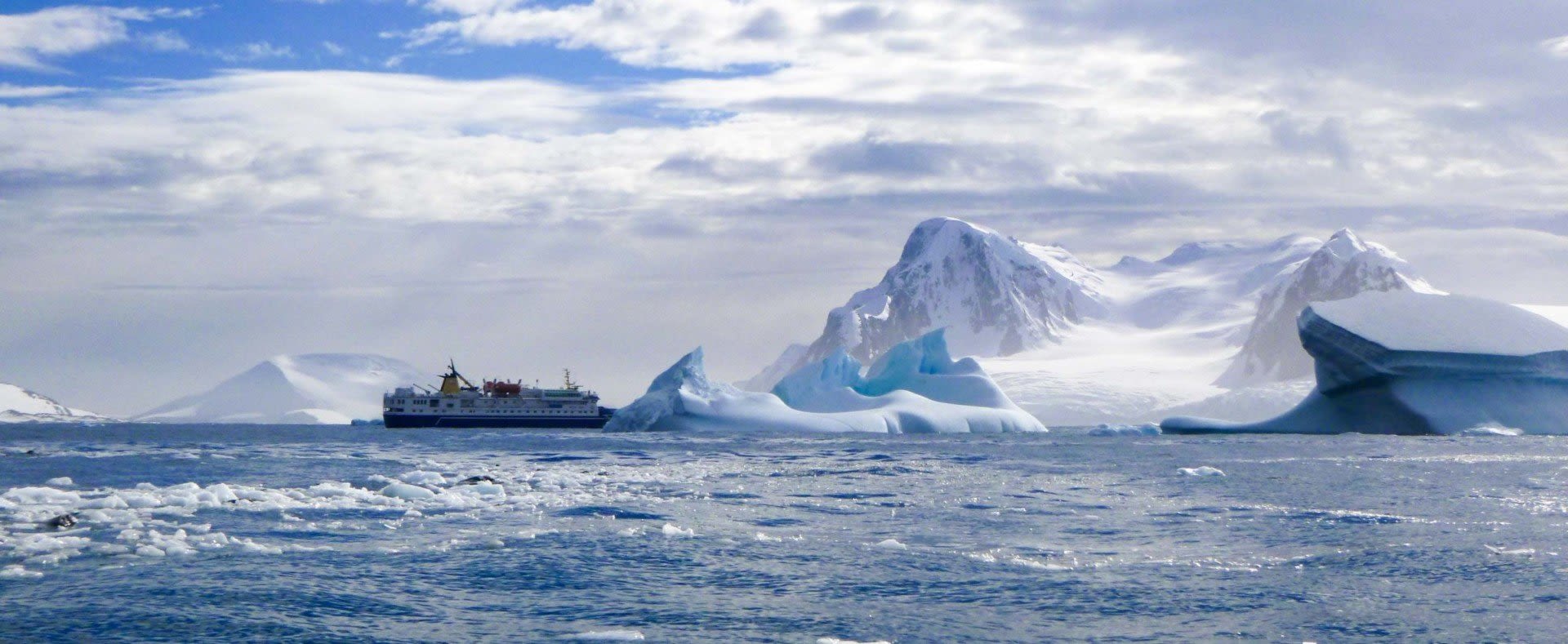
Antarctica has the coldest climate on Earth. The Australian Antarctic Program calls it the coldest, windiest and driest continent, and the lowest air temperature ever recorded on the planet’s surface, −128.6°F (−89.2°C), was measured at Vostok Station on July 21, 1983. The high interior is an ice cap and a desert at once: its highest parts average about −76°F (−60°C) over the year, with less than 2 inches (50 mm) of precipitation. Even the coast averages about 14°F (−10°C), so most of the continent sits below freezing for most of the year.
That is not the Antarctica you will visit. IAATO, the association of Antarctic tour operators, says 98% of tourist voyages operate in the Antarctic Peninsula region during the southern summer. The useful question is how close to freezing the Peninsula sits when you are there. From December to February, average highs at its research stations run 36 to 39°F (2 to 4°C). The seasons are the reverse of North America’s.
These are the 1991–2020 climate normals that Chile’s and Argentina’s weather services filed with the World Meteorological Organization, plus 1991–2020 averages from the British Antarctic Survey’s record for Faraday, today Ukraine’s Vernadsky station. Temperatures in °F, degrees Celsius in parentheses. Summer is the average of December, January and February.
| Station | Where | November average | Summer high / low | Summer average | March average |
|---|---|---|---|---|---|
| Frei (Chile) | King George Island, South Shetlands, 62°S | 30°F (−1.2°C) | 36 / 32°F (2.2 / −0.2°C) | 34°F (0.9°C) | 33°F (0.3°C) |
| Esperanza (Argentina) | Northern tip of the Peninsula, 63°S | 30°F (−0.9°C) | 39 / 29°F (4.0 / −1.7°C) | 34°F (1.1°C) | 28°F (−2.0°C) |
| Faraday/Vernadsky (UK record) | West coast, 65°S | 29°F (−1.7°C) | not in this record | 33°F (0.7°C) | 32°F (−0.1°C) |
| San Martín (Argentina) | Marguerite Bay, 68°S, south of the Antarctic Circle | 29°F (−1.8°C) | 39 / 30°F (3.8 / −1.3°C) | 34°F (1.2°C) | 31°F (−0.8°C) |
The numbers barely move: from the South Shetlands to south of the Antarctic Circle, a summer day averages within a couple of degrees of freezing. Latitude matters less than you would think: Marambio, at 64°S on the Weddell Sea side and 650 feet (198 m) up, averages 30°F (−1.3°C) in summer, colder than San Martín, four degrees of latitude farther south. Of these stations, only Frei’s normals include precipitation, 22.6 inches (574 mm) a year. December is its driest month, with 1.3 inches (32 mm) on about 10 days.
IAATO counts the Peninsula’s tourism season as the seven months from October to April, and most voyages leave from Ushuaia. This page covers the middle five months, November to March. Which weeks suit which wildlife is answered on our page about the best time to visit Antarctica. Here we stick to the weather.
November and March are the cold ends of the season. November averages 29 to 30°F (−2 to −1°C) at all four stations, and snow is frequent: about 15 snowfall days at Esperanza and at Carlini, the Argentine station on King George Island, and 12 at San Martín. The wind is stiffer than in midsummer, 14 knots (16 mph) on average at Esperanza against 10.7 in January. Days are already long: more than 17½ hours on King George Island by mid-month.
The warm middle, by Antarctic standards. Average highs reach 36 to 39°F (2 to 4°C), January is the warmest month at almost every station, and the wind is at its calmest: 6.7 knots (8 mph) in January at Faraday. December is the sunniest month at Esperanza and San Martín, with about 180 hours of sunshine.
Do not expect blue skies every day, though. Carlini logs only 93 hours of sun in December, under a sky that is on average seven-eighths cloud, and even in January snow falls on 9 to 16 days at the stations that count it. At Esperanza the temperature still drops to freezing or below on about 24 days in January.
February still feels like summer, a touch cooler than January. March is where the season turns. Daily averages slip back to 28 to 33°F (−2 to 0°C), snowfall days climb to about 14 or 15 at Esperanza and San Martín, and the wind picks up again. The light goes too: between mid-February and mid-March the day shrinks from about 16 hours to under 13.

The old picture of Antarctic summer as endless daylight is half right. At King George Island the sun is up for 19 hours 52 minutes on the December solstice, and the sky never gets darker than civil twilight. At Faraday/Vernadsky, at 65°S, the day lasts about 22 hours. Cross the Antarctic Circle and the sun does not set at all: at San Martín it stays above the horizon from the solstice through at least mid-January. Ushuaia gets 17 hours 20 minutes on the same December day.
Winter is the mirror image. In late June, King George Island gets about 5 hours of daylight and at San Martín the sun does not rise at all, which is why that station records zero hours of sunshine in June. In summer, bring an eye mask if you sleep badly in light.

The famous winds belong mostly to winter and the ice sheet. Katabatic winds are gravity-fed, cold air pouring off the high plateau; the Australian Antarctic Program says they can exceed 62 mph (100 km/h) for days at a time, and its Mawson station once sat out a seven-day blizzard. On the Peninsula in summer the monthly averages are moderate, and December and January are the calmest months at every Peninsula station we checked in the British Antarctic Survey’s record. Averages hide gusts, so a calm month can still bring a wild day.
Remember that conditions change fast, and the same week can bring warm sunshine and a blizzard. Esperanza holds the record high for the Antarctic continent, 64.9°F (18.3°C) on February 6, 2020, verified by the WMO, and has dropped to 17°F (−8.5°C) in January.
Then there is the Drake Passage between South America and the Peninsula, the chokepoint through which the Antarctic Circumpolar Current is squeezed as it circles the continent. We found no official source that publishes sea-state statistics for the route, so we will not put a number on it. On the classic Antarctica cruise from Ushuaia, the crossing takes about two days each way. To skip it, the Antarctica flight-cruise flies about two hours from Punta Arenas to King George Island and joins the ship there.
This is a continent of extreme climates, so plan and pack accordingly. On the Peninsula in summer the cold itself is rarely the problem. Wet and wind are. Bring waterproof outer layers, gloves, a hat and an insulated mid-layer. Most expedition operators supply a polar-grade parka, and many lend waterproof boots, so check what your voyage includes before you buy. Our Antarctica packing list has the rest.
Most voyages start and end in Patagonia, which has weather of its own: Ushuaia is on our Argentina weather page, Punta Arenas on the Chile weather page, the wider region on our Patagonia weather page. To compare voyages, start with our Antarctica cruises, or ask us to design a custom Antarctica trip around your dates.





